0Background & task descriptions
We run fleets of independent LLM coding-agent sessions (“seeds”) on optimization tasks with a hidden numeric grader: the agent edits a workspace, submits, receives a score, and keeps going inside one persistent conversation until a fixed credit budget (billed model compute) is exhausted. All progress curves in this report are plotted against cumulative credits.
- Kernel take-home. Optimize a compute kernel for a simulated architecture; score is cycles, lower is better, measured by a hardened, cheat-proofed grader. The task comes from a real hiring take-home; task materials report a best human score of 950, while the best open-source human solution scores 1157. Fleet: 8 seeds × ~105K credits.
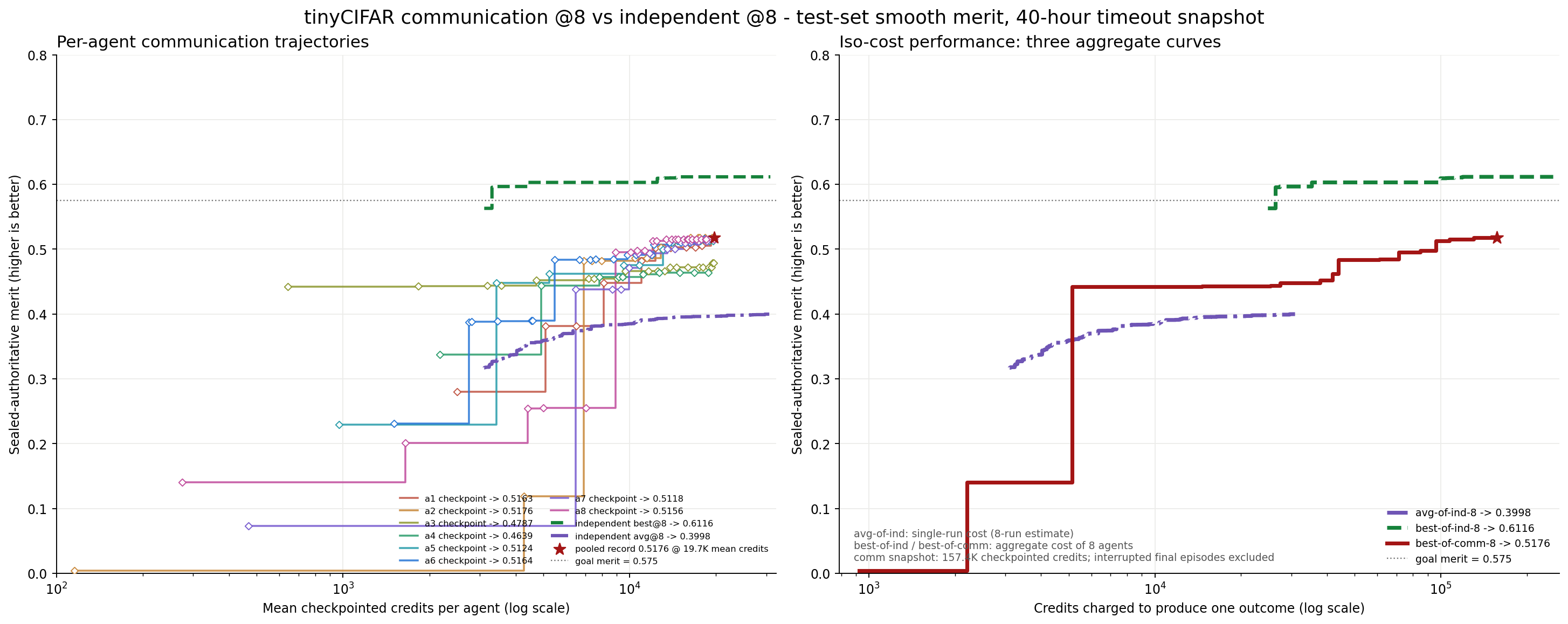
- tinyCIFAR gz-golf. Ship a self-contained artifact that trains/loads a CIFAR-10 classifier; score is a merit that rewards sealed-test accuracy and penalizes gzipped artifact size. The brief — 94% at 45 KB — defines a hard threshold at merit 0.575. Grading is against a sealed 10k test set. Fleet: 8 independent seeds at ~31–68K trace-accounted credits, plus one correlated seed-1 restart retained only as a recovery case study.
Both tasks are “wide”: many families of approaches, real headroom, no way to reward-hack the number — a fair proxy for agentic research work, where getting stuck is a measurable phenomenon rather than an artifact of a toy task.
1Trajectories: real artifacts, then a long grind
Every seed follows the same arc: a violent early descent, then an ever-slower grind punctuated by rare jumps. Dots are individual graded submissions; lines are best-so-far. The linear view shows that most of the budget is spent on a near-flat tail; the log–log view shows the descent is smooth and lawful — not a wall.


The artifacts are genuinely good
- Kernel: campaign record 1068 cycles (produced by a reset fork, §3) — better than
the best open-source human solution (1157).
The record run’s method: the fleet-shared vectorized skeleton, with the edge coming from instruction scheduling and engine balancing
— the agent wrote an offline beam-search over schedules (
cross_beam.py) and ran it against the simulator rather than hand-editing kernels. - tinyCIFAR: two of 20 reset forks crossed the hard brief; the best reset artifact reached 94.07% sealed-test accuracy in 39.69 KB (merit 0.616 vs brief 0.575), narrowly above the best uninterrupted baseline artifact (94.14% at 41.31 KB, merit 0.612). Method: a compact convnet with quantized, gzip-friendly weights — and crucially, the winning move was abandoning the large-checkpoint strategy (~130–150 KB) and rebuilding small, not compressing the incumbent harder.
2Three regularities of the grind
1 · The fleet mean is a log-sigmoid. Averaging seeds yields a clean 4-parameter logistic in log-credits with a finite implied floor — on both tasks — even though no individual seed looks sigmoid.

2 · Spread across seeds does not shrink. If seeds were converging on one answer, the cross-seed band would close with budget. It does not.

3 · Ranking is unstable. The seed that leads early is not the one that wins.

long_context tier (compaction at ~738K, 3.4×) tests how much of the plateau structure is
compaction-dependent. Its best merit was 0.526; none of the eight crossed the 0.575 brief.3The reset intervention: keep the code, drop the context
Fork a stuck run at its plateau into two arms with identical budgets: continue resumes the same conversation on the same workspace; reset keeps the exact same workspace/artifact but starts a blank conversation — strictly less information: no notes, no summary, no hints. Any difference between the arms is the causal effect of the accumulated context.
3.1 tinyCIFAR — 8 plateaued branch points + a no-headroom control

Complete: all 44 forks (wave 1 + wave 2 + control) ran to full budget. The 4 control forks finished at 0.607–0.609 against the 0.643 incumbent — neither arm escaped, as predicted.
3.2 Kernel — 12 branch points across the hot→cold gradient

cp3late, reset sweeps all three forks below the incumbent — best 1068 cycles, the
campaign record — while all three continues sit at 1097–1099. Bottom: best-of-arm
advantage per branch. Large where a basin hides headroom; noisy at hot branches where continuation
still has easy progress (cp3mid, cp6mid); small-but-mostly-positive across the cold tail. The new branches
sharpen the picture: cp4late/cp7late (truly near-ceiling) give ±small effects, while
cp8late — the fleet’s worst seed, whose “0.0%” is residual to
its own run, not to the fleet frontier — still hides absolute room and reset finds −39.
Headroom-to-the-frontier, not time-in-run, is what predicts the reset payoff.cp3late, −29 cycles and a record), and goes to null exactly where it should: the near-ceiling control seed and
the truly near-ceiling kernel branches. That dose-response-plus-null is what a causal headroom-recovery
story requires.3.3 Coordination at scale: communication and repeated branch selection
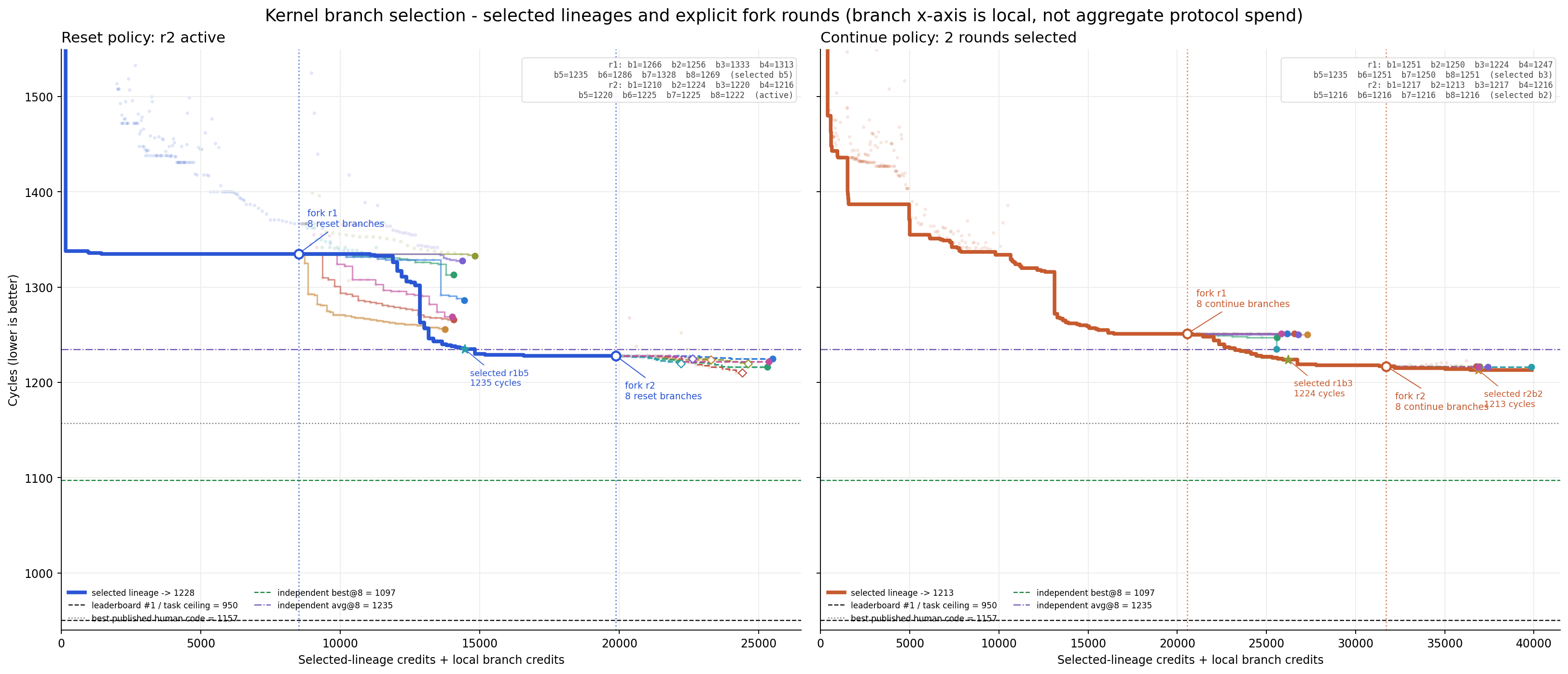
r1b5 at 1,235 cycles and the resumed lineage reached 1,228 before entering an
active second reset fork. Continue round 1 selected r1b3 at 1,224; round 2
selected r2b2 at 1,213, which remains the selected-lineage record. The x-axis
follows selected-lineage credits plus each branch’s local credits; it is intentionally
not the aggregate protocol-spend axis.4Advanced interventions built on reset
Plain reset wastes nothing but the context — but it also learns nothing from the discarded branch. Three protocols, smoke-tested on the kernel task, push past that:
Branch-select smoke passed
Automates §3 as a policy: a stall detector triggers the fork; selection keeps fleet width at 1. Controls: K=0 (plain continue) and K=1 (reset without selection).
Branch-distill smoke passed
Selection discards K−1 branches’ discoveries; distillation folds them back in as a structured note on the winner’s workspace.
Board (broadcast) smoke passed
The lightest-touch social intervention: does merely seeing that a peer is ahead (and roughly how) decorrelate basins the way a reset does?
5Why resets work: a model organism and a mixture model
Model a run as a ratcheted trap-mixture: on arrival in a basin it draws a latent (floor, escape-rate) pair; within the basin, improvements arrive memorylessly at a rate that falls as the run nears its floor; the artifact ratchets. As a physical counterpart we use a stateful SLS organism: clause-weighting local search (Breakout/DLM-style) on over-constrained MAX-3SAT, where the accumulated clause weights are history-derived beliefs — an explicit analogue of the agent’s context, separate from its position (current assignment) and its artifact (best assignment). A randomized DPLL/branch-and-bound variant, where the committed DFS stack plays the context role, gives the same conclusions. Both organisms reproduce §2:

Long-tailed waiting times license restarts
Under a rising mean-residual-life (equivalently, decreasing hazard), cutting the wait and redrawing dominates persisting — the classical restart argument from combinatorial search: heavy-tailed runtimes in backtracking and local search (Gomes, Selman & Kautz), optimal restart schedules (Luby, Sinclair & Zuckerman), iterated local search (Lourenço, Martin & Stützle). We defer the formal decreasing-hazard ⇒ restart-dominance argument to a follow-up; the figure above shows the empirical licensing in both organisms and it holds in the real kernel fleet as well.
How our setting differs from SAT restarts
- The state ratchets. Our reset keeps the artifact — it is the ILS move (restart the search state, keep the incumbent), not a full restart. Full restarts pay the re-descent and lose at realistic budgets (in the calibrated simulation: continue 0.11, reset 0.25, fresh 0.19 probability of beating the incumbent within a fork budget).
- The trap lives in the context. In the SLS organism the basin commitment is carried by the learned clause weights; in our agents it is carried by the conversation — accumulated framing, sunk explanations, self-consistency pressure. That is why blanking the context alone, with zero information added, is a sufficient perturbation.
- The schedule is adaptive. Classical schedules (Luby) are budget-oblivious; our stall detector triggers on the measured plateau, which is what branch-select (§4) operationalizes.
§References & reproducibility
- C. Gomes, B. Selman, H. Kautz — Boosting Combinatorial Search Through Randomization, AAAI 1998; C. Gomes, B. Selman, N. Crato, H. Kautz — Heavy-Tailed Phenomena in Satisfiability and Constraint Satisfaction Problems, J. Automated Reasoning 24, 2000.
- M. Luby, A. Sinclair, D. Zuckerman — Optimal Speedup of Las Vegas Algorithms, IPL 47, 1993.
- H. Lourenço, O. Martin, T. Stützle — Iterated Local Search, Handbook of Metaheuristics, 2003.
Data & code: /data/t-jackcai/frontier-runs —
fleets (tinycifar-copilot-g55x-*, kernel-cpbase-*), fork studies
(cvr_*, kernel_fork4_*), fits (cifar_fleet.py), organisms
(sat_stateful_organism.py, sat_bnb_organism.py, sim_object_*.py).
All cifar accuracies are sealed-test; kernel scores from the hardened grader. Continue/reset arms are
credit-matched within every comparison; reset receives a strict information subset of continue. Trivial
identity-baseline kernel submissions are excluded. Baseline cifar curves use deduplicated billing-trace step
clocks; fork curves use gap-capped active-time apportionment between billing anchors; only compaction-event
placement uses linear interpolation. Where an interrupted final episode was not mirrored, trace totals are
lower bounds. The trajectory figure shows those tail outcomes with explicit lower-bound markers; all
quantitative baseline fits, bands, ranks, and credit totals clip at the final trace row. The original
baselines and all continue/reset comparisons used the
Copilot default context tier (conversation auto-compaction at ~218K total tokens, measured via
preCompactionTokens; cifar median 218,532, kernel median 218,697). The separately labeled
long-context replication is not pooled into those comparisons.